Learning path Practice studio Your progress 0/33 complete
A practical course for better thinking
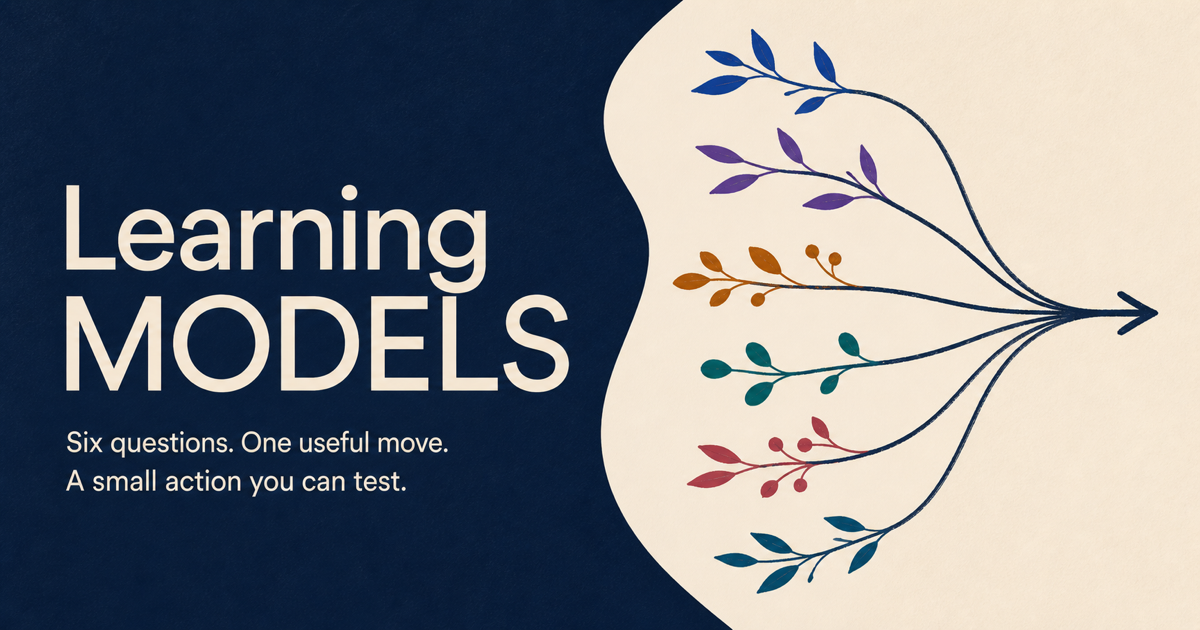
Learn six questions. Mental models are powerful, but each one can hide several moves—and there are too many to memorize. MODELS gives you six places to look, then reveals deeper tools only when they help.
13 modules33 short lessons7–10 guided hours plus field practice total0 completed here
Start broad. Find the bottleneck. Make one useful move. The whole idea in one minute
A model library tells you what ideas exist. MODELS helps you decide what kind of change this moment needs. M Map Show it differently
O Options Find another path
D Destination Define better
E Evidence Let reality answer
L Loop Change the next turn
S System Arrange the work
How every lesson works
Experience it before you have to name it. Each lesson adds one relationship. The guidance fades as you gain control.
1 Notice Start with an ordinary stuck moment. 2 Change one thing Move one input and see one consequence. 3 Connect Place the idea in the larger system. 4 Distinguish Compare it with the closest wrong move. 5 Act and return Try a bounded action, then retrieve it later. Use boundary Ordinary-life learning, with real-world authority left intact. MODELS is not clinical, emergency, legal, or other qualified professional care. When those authorities are appropriate, they take precedence. If a clear and immediate risk of serious harm appears, pause the exercise and help the person reach appropriate support.
Module 0 0/2
Start here
Six ways thinking can be stuck Experience the six changes before learning their names.
0.1 One situation, six useful changes 10 min Not completed 0.2 The six-letter compass 12 min Not completed Module 1 0/3
Operational thinking
Make a thinking move earn its keep Turn insight into a bounded change that can meet reality.
1.1 One bounded move 12 min Not completed 1.2 The five-part action plan 14 min Not completed 1.3 Predict, observe, revise 12 min Not completed Module 2 0/3
MAP
M: change the map, keep the facts Change the representation so the needed inference or action becomes easier.
2.1 Same facts, different map 12 min Not completed 2.2 Four ways to remap 14 min Not completed 2.3 REMAP and Effective? 15 min Not completed Module 3 0/3
OPTIONS
O: find genuinely different actions Expand the candidate set by changing the mechanism, not the adjectives.
3.1 Diagnose a stuck option set 12 min Not completed 3.2 Change one option handle 14 min Not completed 3.3 RANGE and a testable choice 15 min Not completed Module 4 0/3
DESTINATION
D: decide what better actually means Define the legitimate result, beneficiaries, bounds, and revision rights.
4.1 Detect destination drift 12 min Not completed 4.2 Value, legitimacy, and bounds 15 min Not completed 4.3 Choose the right destination shape 15 min Not completed Module 5 0/3
EVIDENCE
E: let reality answer a decision Acquire only the information that can change a live decision.
5.1 Is more evidence worth acquiring? 12 min Not completed 5.2 Rivals before results 14 min Not completed 5.3 Contact, quality, update 15 min Not completed Module 6 0/3
LOOP & DYNAMICS
L: change what happens on the next turn Trace stored state and update processes that keep regenerating a pattern.
6.1 See the trajectory and find the memory 13 min Not completed 6.2 Close the circuit honestly 14 min Not completed 6.3 Change the update process 15 min Not completed Module 7 0/3
SYSTEM
S: compose people, tools, and environments Fit work packets to carriers, interfaces, authority, and checks.
7.1 A system is not wholesale offloading 12 min Not completed 7.2 Carve before assigning 14 min Not completed 7.3 Assemble, guard, and tune 15 min Not completed Optional 0/1
Optional STATE support
When the needed ability is hard to reach Loosen the resourcefulness trap without turning it into a seventh MODELS area or a readiness test.
8.1 Loosen the resourcefulness trap 10 min Not completed Module 9 0/3
Contrast and correction
Choose the right kind of help Distinguish neighbors, preserve rivals, and choose intelligent non-use.
9.1 Minimal pairs 14 min Not completed 9.2 Same surface, six bottlenecks 14 min Not completed 9.3 Intelligent non-use and correction 15 min Not completed Module 10 0/2
From stuckness to observation
Run a complete MODELS episode Use the Canvas without turning every problem into paperwork.
10.1 Use the Canvas 16 min Not completed 10.2 From stuckness to observed result 16 min Not completed Module 11 0/3
Fading and transfer
Transfer control from guide to learner Remove the framework support while preserving accessibility and appropriate non-use.
11.1 Fade the help 12 min Not completed 11.2 Transfer and withhold 14 min Not completed 11.3 Return later and reconstruct 10 min Not completed Module 12 0/1
Decision lab
Capstone: change one future decision Use the smallest justified part of MODELS on one suitable decision.
12.1 One live decision, one bounded experiment 25 min Not completed Evidence boundary This course teaches a designed system; it does not promise an outcome. This is an evidence-informed teaching design for a candidate system. Course completion does not establish improved thinking, transfer, or capability.
Course status: designed, not yet tested with learners. Examples teach use of the system; they do not guarantee a result. Qualified clinical, emergency, legal, or other responsible authority takes precedence when appropriate.